The Brazilian jiu-jitsu community is grieving after a competitor died during the IBJJF Chicago Summer Open earlier this month—a Tragic loss that instantly turned into a hard conversation about medical readiness at tournaments. In its official statement, the International Brazilian Jiu-Jitsu Federation said the medical emergency occurred shortly after the athlete had completed a match, that “IBJJF staff, along with trained medical personnel and other qualified first responders acted immediately,” and that the athlete was transported by ambulance. The organization expressed “profound sadness” and emphasized that life-saving protocols were used. IBJJF
Separate reports circulating in the BJJ press and on social media painted a different early picture: eyewitness accounts claimed delays in initiating CPR and the absence of an on-site AED and paramedics, allegations that—if true—would contradict the idea of a fully prepared venue. These versions largely trace back to witness threads and subsequent summaries by BJJ news sites that aggregated what people in the stands said they saw. At the time of writing, those outlets stress that details remain limited pending official clarification. Bjj Eastern EuropeJiu Jitsu LegacyBJJ World
Several outlets have identified the competitor as Alvis E. Villarreal, a white belt in the Master 4 division, and place the incident at the Chicago Summer International Open on August 10, 2025. As with all breaking news, those identifications rely on public records and early reports; the family, teammates, and organizers deserve accuracy and care as more facts are confirmed. Yahoo SportsMiddleEasy
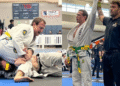



What we know—and what remains contested
What’s uncontested is the tragedy: an athlete collapsed after competing and later died. The IBJJF’s account emphasizes the presence of trained medical personnel and immediate action, followed by EMS transport. The early witness accounts—amplified by BJJ news sites—allege that bystanders initiated CPR after a multi-minute delay, and that there was no on-site AED or paramedic team stationed at the venue. These are serious claims, and they matter because minutes are the difference between life and death during sudden cardiac arrest (SCA). IBJJFBjj Eastern EuropeJitsmagazine.com
Sports-medicine guidance is blunt on this point. The American Heart Association notes that early CPR and defibrillation can double or triple survival, with survival rates dropping 7–10% for every minute without defibrillation; in some settings, defibrillation within three minutes is associated with dramatically higher survival. That’s why best-practice checklists for athletic events insist on accessible AEDs, rehearsed emergency action plans (EAPs), and trained responders on site. cpr.heart.org+1AHA Journals
The bigger question: are BJJ events medically ready?
BJJ has professionalized fast—broadcast deals, packed calendars, slick production—but medical standards across events vary widely. Some promotions run with ringside physicians, onsite AEDs per mat, and formal pre-event medical meetings; others treat medical prep like a box to check. Position statements and consensus papers across sport don’t leave much wiggle room: every venue should have a written EAP, an AED within a short walk of each active area, and staff who have drilled the plan so that recognition → CPR → shock happens in minutes, not “eventually.” PMC
The Chicago incident lays bare the stakes. Whether the night met or missed that standard is precisely what the community—and likely the lawyers and insurers—will examine. But even before those answers arrive, the path forward looks the same: publish the plan, drill the plan, and measure response times the way we measure bracket starts.
What “better” looks like (and how to do it now)
It starts with transparency. Tournament organizers can publish their Emergency Action Plan on event pages: who’s in charge, where AEDs live, what the site-specific call tree is, and how to direct EMS to the exact mat. Many collegiate and high-school programs already do this—there’s no reason a global BJJ federation couldn’t set the bar. The NATA and AHA both provide accessible frameworks: assign roles, stage equipment, practice arrival and egress routes, and audit the plan annually. PMCcpr.heart.org
Then, the equipment reality: an AED costs less than a single team’s travel for a regional open and weighs under seven pounds. Place one per mat bank (or better), with a bright tag and a map in the coach packet. Check batteries and pads before the doors open. Train volunteers to fetch while the nearest trained responder starts compressions. If your promotion can hire camera ops, it can hire an onsite EMT/ATC and rent two AEDs. The ROI is measured in lives saved and reputations kept. cpr.heart.org
Finally, rehearsal. Walk the staff through a two-minute drill: collapse recognized → shouter calls 911 and points someone to the door for EMS → responder starts compressions → runner brings AED → pads on, shock delivered if indicated. Time it. Do it again until it’s under three minutes from collapse to shock in the drill. That’s the standard other sports aim for; that’s the standard a world-class grappling federation should expect of itself. www.heart.org
A note on compassion and caution
There’s a family grieving behind every headline. The urge to assign blame fast is human, but accuracy matters more. The IBJJF has issued a statement; independent outlets and witnesses have provided sometimes conflicting details; more information will emerge. The useful work for the community right now is to push for uniform medical standards regardless of what any single investigation concludes. If this loss leads to AEDs at every mat bank and rehearsed EAPs at every event, it won’t balance the ledger—but it will honor the athlete by reducing the chance it happens again. IBJJF